

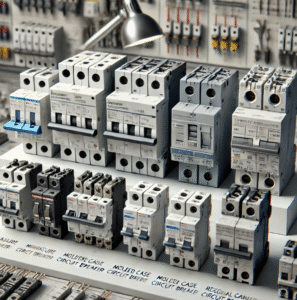
In today’s rapidly evolving energy landscape, businesses focused on electrical circuit breakers must adapt to shifting market dynamics, technological innovations, and sustainability expectations. Whether you manufacture, distribute, maintain, or retrofit circuit breakers, there’s a wealth of opportunity ahead. This article explores how to improve your electrical circuit breaker business—and transform challenges into competitive advantage. You’ll find insights grounded in industry trends, best practices, and strategic moves that can elevate your offering and drive growth. Let’s flip the switch and get energized! ⚡
Improving Market Awareness and Positioning
Understanding the market’s trajectory is key. The global circuit breaker industry shows robust growth potential: estimates place its size at around $24.4 billion in 2025, projected to reach $42.8 billion by 2032 with a compound annual growth rate (CAGR) of about 8.37% Fortune Business Insights. Other reports similarly forecast strong expansion—one predicts a rise from $17.2 billion in 2024 to $26.8 billion by 2029 (CAGR ~9.2%) BCC Research Blog. In the U.S., modernization of the electric grid and renewable integration are expected to push the market beyond $6.5 billion by 2034 Global Market Insights Inc..
To improve your business, first benchmark where you stand in the market: Are you positioned in residential, commercial, industrial? Do you focus on traditional breakers or smart, grid-connected solutions? Investing in market research, attending trade events, and analyzing competitor moves will sharpen your understanding and help tailor your strategy.
Diversify Your Product and Service Offerings
A strong way to advance your business is expansion—into services and innovative products.
-
Retrofit, life-extension, and reconditioning services are increasingly valuable. Companies like Eaton offer Class 1 reconditioning for medium- and low-voltage breakers to enhance system coordination and extend equipment lifespan Eaton. CBS (Circuit Breaker Sales) offers life-extension programs for obsolete gear, improving reliability and reducing replacement costs Circuit Breaker Sales.
-
Smart and app-enabled solutions are gaining traction. For example, Savant’s Smart Budget platform allows homeowners to manage circuit loads via app—an efficient alternative to costly utility service upgrades The Verge. Think about how you might offer similar integrations or partner with smart controls manufacturers to deliver digital value.
-
Digital modernization of electrical infrastructure paying off. Schneider Electric emphasizes the benefits of transforming legacy installations with digitized equipment—for improved reliability, reduced downtime, and longer asset life Schneider Electric.
Adding smart, retrofit, and modernization services helps you tap into new revenue streams, deepen customer relationships, and position your business as forward-thinking.
Leverage Industry Trends and Strategic Partnerships
Staying on top of industry momentum can open doors:
-
There’s a surge in U.S. production of grid hardware—driven by electrification, data center growth, and renewable integration. Hitachi Energy is investing $70 million in Pennsylvania to double high-voltage breaker output and launch a workforce training center. Mitsubishi is building an $86 million switchgear factory and test lab set to boost capacity by 2026 Axios. Aligning your offering to areas undergoing heavy investment—utilities, data centers, solar farms—can position your business for partnership or supplier inclusion.
-
Focus on sustainability and recycling. Organizations like PEARL (Professional Electrical Apparatus Reconditioning League) advocate reconditioning—turning reuse into responsible, revenue-driving service. By promoting remanufacturing and inspection services, you support safety, cost-efficiency, and environmental stewardship Wikipedia.
Proactively forging strategic alliances—with manufacturers, grid operators, sustainability bodies, and educational institutions—can multiply your visibility and credibility.
Strengthen Safety, Quality, and Compliance
Safety and regulatory compliance are non-negotiable in any electrical business.
-
Offer remote racking systems that improve worker safety by allowing breakers to be operated from a safe distance—reducing arc-flash risks Wikipedia. Marketing such advantages can attract clients who prioritize safety.
-
Keep abreast of code updates like AFCI (arc-fault circuit interrupter) requirements for residential circuits, common across North America Wikipedia. Ensuring your products and services comply positions your firm as trustworthy and knowledgeable.
-
Consider enrollment or promotion of reconditioning standards from bodies like PEARL, which also supports anti-counterfeit measures and best practices Wikipedia.
By championing safety and quality, you earn trust. In electrical work, trust is power.
Invest in Talent, Training, and Customer Education
Your human capital is essential for improvement.
-
As seen with Hitachi’s new training center, investing in skilled workforce development ensures you have the technical capabilities to scale Axios.
-
Equip your team with expertise in smart grid trends, remote equipment, code updates, and reconditioning techniques.
-
Educate your customers through workshops, webinars, whitepapers, or newsletters—help them understand risks of outdated panels, benefits of smart upgrades, and codes like AFCI. Content marketing can both inform and convert.
Building the right internal skills and educating your market can set the stage for sustainable growth.
Enhance Marketing, Branding, and Thought Leadership
To stand out, actively shape perception.
-
Develop case studies—e.g., a successful reconditioning job that saved a client time and money, or a retrofit that enabled smart energy management.
-
Share insights on energy savings, safety improvements, or smart panel benefits on your website and social channels.
-
Contribute articles or op-eds to reputable business news outlets and cite industry trends. For instance, referencing the expansion of breaker manufacturing in Pennsylvania from Axios can lend gravitas to your messaging Axios.
-
Offer downloadable guides on breaker maintenance, panel upgrades, or selecting digital solutions—helping position your company as a trusted advisor.
Thought leadership builds brand presence and drives inbound interest.
Monitor Performance and Stay Agile
Continuous improvement stems from feedback and adaptation.
-
Track key performance indicators: project lead times, equipment downtime, repeat business, and customer satisfaction.
-
Use tools like outage management systems (OMS) to understand how circuit breaker performance affects broader grid reliability Wikipedia. Insights from these systems can inform product development and service focus.
-
Be ready to pivot as regulatory, tech, or market landscapes shift—for instance, new smart grid mandates or end-of-life infrastructure replacements.
By measuring, learning, and adjusting, your business stays nimble and resilient.
Conclusion
Your electrical circuit breakers business has many pathways to improvement: deepening market intelligence, expanding services with smart and retrofit solutions, forging strategic ties, emphasizing safety and compliance, investing in talent, shaping your brand through thought leadership, and embracing data-driven agility.
Execute a multi-pronged strategy and you’ll generate greater growth, customer trust, and long-term sustainability. The circuit breaker industry is not just about keeping the lights on—it’s about powering the future. Flip that switch, and let’s energize your business! 😊
Business News Sources
-
Axios – Energy demand powers appetite for grid gear (used once) Axios
-
The Verge – Smart breaker box system (used once) The Verge
-
Business Insights publication (Fortune Business Insights on market size projections) Fortune Business Insights
